DEAR SOPHIA,
YOU, AS A BYZANTINE GREEK ROMAN, SHOULD UNDERSTAND THE PRESENT DAY POLITICS AND WORLD SITUATION IN ALL ASPECTS IS A COLLISION OF THE THREE DATES THAT DEMARCATE CRUCIAL TURNING POINTS IN WESTERN CIVILIZATION AFTER THE ADVENT OF CHRISTIANITY. THIS OPINION PIECE IS AN ACCURATE OBSERVATION OF ONE OF THE UNDERCURRENTS OF CONFLICT BETWEEN THE EAST AND WEST. PLEASE READ AND ANALYZE FOR YOURSELF THIS OPINION PIECE BELOW.
143
LOVE,
DAD
https://www.ekathimerini.com/tag/ecumenical-patriarchate-of-constantinople/
Orthodoxy as a weapon of the Kremlin

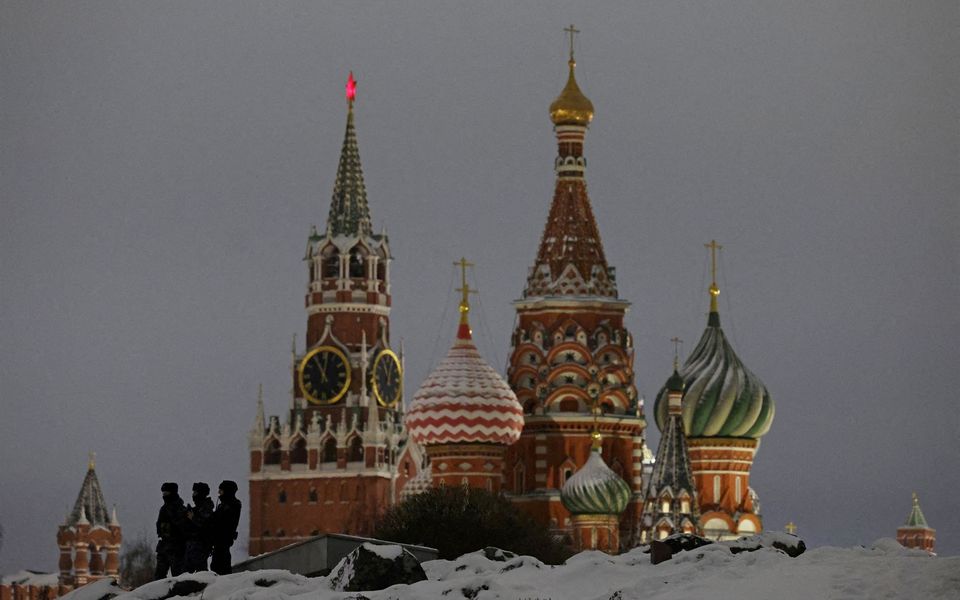
The Spasskaya tower of the Kremlin and St. Basil’s Cathedral in Moscow, on December 31. [Anastasia Barashkova/Reuters]
Nikos Kouremenos
The recent Russian barbs directed at the Ecumenical Patriarchate, beyond their immediate relevance, point to something deeper: They reveal how easily religion can be transformed into a substitute for strategy and a tool of war. The instrumentalization of religion by the Russian state is not a contingent phenomenon. It is a deliberate method with deep roots, intertwining tsarist legacies, Soviet practices, and post-Soviet ambitions. This is not a marginal development, but a structural feature of the contemporary Russian state – one that also affects our own public sphere.
At the heart of this instrumentalization lies the ideology of the so-called “Russian world.” This is the notion that Orthodoxy, the Russian language, and a shared historical memory constitute a single cultural and civilizational space, within which Moscow assumes the role of a natural center and protector. In this way, a spiritual identity is recast as a geopolitical doctrine, where unity presupposes influence and “protection” can legitimize even military intervention. Religious language is thus mobilized to cloak political power with the aura of a sacred mission. Within this framework, the West is portrayed as morally degenerate, while the “Russian world” presents itself as a bastion of tradition. The result is an identity-driven theology that readily becomes a mechanism of cultural warfare and the demonization of the other.
For this very reason, it is significant that clear theological resistance has emerged from within the Orthodox world itself. A “Declaration on the ‘Russian World’ (Russkii mir) Teaching” (2022) explicitly rejected this ideology as a distortion of the Orthodox tradition and a form of ethnophyletism, affirming that the Church cannot be reduced to an ideological instrument for the sacralization of a nation or an imperial fantasy. Along similar lines – though in a different language and addressed to a broader audience – the recent statement of the Conference of European Churches (CEC), issued at the Helsinki conference in December 2025, made the same point. It speaks candidly about the blurring of boundaries between political ideology and theology, the demonization of the West through a “dualistic” cultural war, and the theological inadmissibility of concepts such as “holy war” or the metaphysical self-presentation of a state.
The critical issue here is not the West as a geographical entity, but the West as a constructed scarecrow. When the opponent is portrayed as metaphysical evil – as “decadence,” “atheism,” “anti-tradition,” or “against nature” – political confrontation exits the realm of rational argument and becomes a mechanism of emotional mobilization. In such cases, religious faith ceases to illuminate human conscience and instead recruits it for a dubious sacred cause. At the same time, theological discourse loses its prophetic character and adorns political power with a halo.
The danger for our own country is tangible, precisely because Greece continues to possess substantial religious capital. Within our public sphere, a narrative circulates – at varying levels of intensity – that conflates Orthodoxy with anti-Westernism, piety with conspiracy thinking, and legitimate criticism of Western pathologies with the justification of authoritarian models. In this way, adherents of dangerous ideas are formed – people who do not merely seek to defend a tradition, but who embrace an enemy-centered worldview in which democracy and European institutions are deemed untrustworthy and any dissent is equated with betrayal. This is not an innocent form of conservatism, but a culturally polarizing posture draped in religious language which, in periods of international instability such as the present one, can operate as a channel of foreign influence – primarily through the internalization of a distorted interpretive framework.
The appropriate response to these challenges is not the “de-religionization” of society, but the safeguarding of clear boundaries. We must cultivate an awareness that faith is one thing and state strategy another; that the witness of the Gospel is one thing and the legitimization of authoritarian regimes another; and, finally, that criticism of the West is one thing and its demonization another. What our society needs is a form of theological education that demystifies the sacralization of power, remains alert to the spread of hatred and disinformation, and nurtures the maturity required to understand Orthodoxy – and religious faith more broadly – not as the banner of a geopolitical camp, but as an invitation to a loving communion of persons grounded in freedom and peace.
Nikos Kouremenos is a research fellow at the Volos Academy for Theological Studies.
 Fanady blog