DEAR SOPHIA,
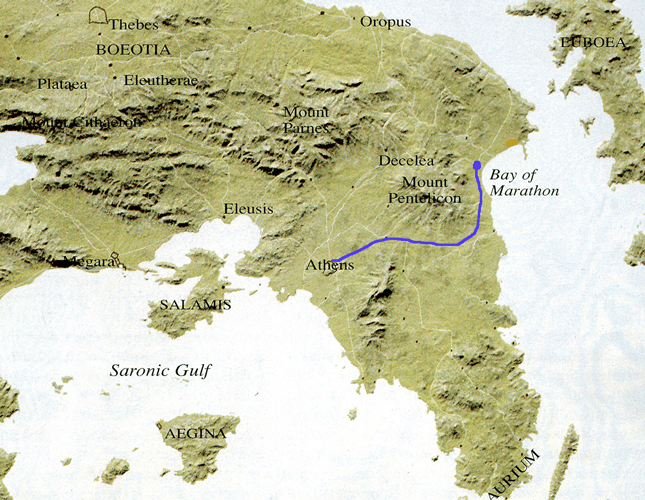
ALL OVER THE WORLD CITIES AND NATIONS RUN A RACE CALLED THE MARATHON. THEY NEVER TELL YOU WHAT THE ORIGIN OF THE MARATHON IS. WELL, OF COURSE, ITS ORIGIN IS GREEK. SIMPLY PUT IT WAS THE ACT OF RUNNING FROM MARATHON IN GREECE TO ATHENS TO ANNOUNCE TO THE ATHENIANS THAT THE BATTLE BETWEEN THE PERSIANS AND THE ATHENIANS WAS WON BY THE ATHENIANS. THIS WAS THE PRECURSOR BATTLE TO THE ONE THAT TOOK PLACE 10 YEARS LATER. THE RUNNER RAN THE ENTIRE DISTANCE TO ATHENS, GAVE THE MESSAGE OF ONE WORD, “NIKE,” WHICH MEANS VICTORY AND THEN HE DROPPED DEAD. 2,500 YEARS LATER WE ARE STILL IN A CONFLICT WITH PERSIA. HERE IS A LITTLE BIT MORE HISTORY BELOW.
BE PROUD.
143
LOVE,
DAD
The name Marathon comes from the legend of Pheidippides, the Greek messenger. The legend states that while he was taking part in the Battle of Marathon, which took place in August or September 490 BC,[3] he witnessed a Persian vessel changing its course towards Athens as the battle was near a victorious end for the Greek army. He interpreted this as an attempt by the defeated Persians to rush into the city to claim a false victory or simply raid,[4] hence claiming their authority over Greek land. It was said that he ran the entire distance to Athens without stopping, discarding his weapons and even clothes to lose as much weight as possible, and burst into the assembly, exclaiming “we have won!”, before collapsing and dying.[5]
The account of the run from Marathon to Athens first appeared in Plutarch‘s On the Glory of Athens in the first century AD, which quoted from Heraclides Ponticus‘s lost work, giving the runner’s name as either Thersipus of Erchius or Eucles.[6] Satirist Lucian of Samosata gave one of the earliest accounts similar to the modern version of the story, but its historical veracity is disputed based on its tongue-in-cheek writing and the runner being referred to as Philippides and not Pheidippides.[7][8]
There is debate about the historical accuracy of this legend.[9][10] The Greek historian Herodotus, the main source for the Greco-Persian Wars, mentioned Philippides as the messenger who ran from Athens to Sparta asking for help, and then ran back, a distance of over 240 kilometres (150 mi) each way.[11] In some Herodotus manuscripts, the name of the runner between Athens and Sparta is given as Philippides. Herodotus makes no mention of a messenger sent from Marathon to Athens and relates that the main part of the Athenian army, having fought and won the grueling battle and fearing a naval raid by the Persian fleet against an undefended Athens, marched quickly back from the battle to Athens, arriving the same day.[12]

