DEAR SOPHIA,
THIS TRAP IS BETWEEN THE OCCIDENTAL AND THE ORIENT. THE LIKELIHOOD OF WAR IN THE NEXT 15 YEARS IS ABOVE 99% AND LESS THAN 100. IT IS A WAR BETWEEN TWO CIVILIZATIONS, AND IT WILL BE A GREATER CONFLICT IN PRINCIPLE THAN WORLD WAR II. THIS IS BECAUSE IT IS NOT A WESTERN WAR THAT EXPANDED INTO A GLOBAL WAR BUT IT IS A WAR BETWEEN A RISING EASTERN CIVILIZATION AND THE WEST. BELOW IS SOME ANALYSIS THAT YOU SHOULD REVIEW. at some point it is a certainty i will be in a position to secure your future so that you will not be greatly impacted by this upcoming conflict.
143
love,
dad
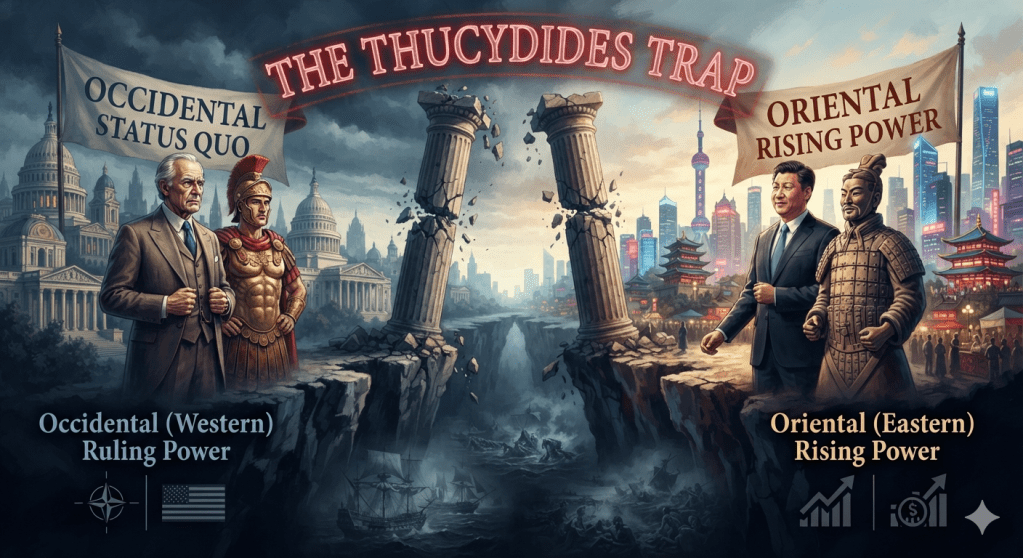
The “Thucydides’ Trap” between the Occidental (Western, led by the US) and Oriental (Eastern, led by China) worlds refers to the severe risk of inevitable war when an emerging global power threatens to displace an existing ruling power. [1]
This structural stress, popularized by Harvard political scientist Graham Allison, historically results in violent conflict 75% of the time. [1, 2]
Core Dynamic of the Tension
- The Established Hegemon: The United States and its Western allies seek to preserve the rules-based international order, maritime dominance, and democratic alliances established post-WWII. [1, 2]
- The Rising Challenger: China seeks to reclaim its historic status as the dominant power in Asia, secure its maritime borders, and rewrite global financial and political institutions to reflect its economic weight. [1, 2]
Key Flashpoints and Structural Drivers
| Domain | Occidental (Western) Position | Oriental (Chinese) Position |
|---|---|---|
| Geopolitics | Defends Taiwan’s autonomy and enforces freedom of navigation in the South China Sea. | Views Taiwan as a core sovereignty issue and claims historical jurisdiction over the South China Sea. |
| Technology | Implements export controls, semiconductor restrictions, and AI safeguards to maintain a military edge. | Pursues tech self-reliance through state-subsidized programs like “Made in China” to break Western monopolies. |
| Economics | Pushes for “de-risking” supply chains and uses tariffs to protect domestic green-tech industries. | Expands global trade dominance via the Belt and Road Initiative and seeks alternative financial clearing systems. |
| Ideology | Champions liberal democracy, universal human rights, and multilateral alliances like NATO and the G7. | Promotes state-led capitalism, non-interference in domestic affairs, and alternative blocs like the BRICS coalition. |
Historical Context and Outlets
The term originates from the ancient Greek historian Thucydides, who observed that “it was the rise of Athens and the fear that this inspired in Sparta that made war inevitable.” [1, 2, 3, 4]
In modern geopolitical analysis, avoiding this trap does not require total agreement. Instead, experts suggest establishing explicit communication channels, creating mutual economic interdependencies, and finding common ground on global threats like artificial intelligence safety and climate mitigation. [1, 2]
Deep Roots of the Occidental-Oriental Divide
The friction between the United States and China extends beyond standard superpower rivalry. It represents a fundamental clash between two distinct civilizational philosophies on how society, power, and international relations should function.
       [ OCCIDENTAL PERSPECTIVE ]                  [ ORIENTAL PERSPECTIVE ]
    Individualism & Rule of Law (US/West)       Collective Harmony & Hierarchy (China)
                    \                                    /
                     \                                  /
                      v                                v
                [ Rules-Based International Order ]  [ Multipolar / Sovereign Equality ]
                                  \                /
                                   v              v
                            [ THE THUCYDIDES' TRAP ]
                        Structural Stress of Power Shift
1. Individualism vs. Collective Harmony
- The West: Prioritizes individual liberty, political rights, and the rule of law. Society is viewed as a contract between free individuals, and government power must be legally constrained.
- The East: Roots its governance in Confucian philosophy, which prioritizes collective stability, social harmony, and filial obligation to the state. The individual’s needs are often subordinated to the welfare and order of the nation.
2. Universalism vs. Civilization-State
- The West: Believes that liberal democracy and human rights are universal values that all nations should eventually adopt. This drives a foreign policy focused on democracy promotion.
- The East: Views China not merely as a nation-state, but as a unique “civilization-state.” Its leadership rejects Western universalism as cultural imperialism, arguing that each civilization has the sovereign right to govern itself according to its own history and values.
Structural Safeguards: Preventing the Trap
While history shows a 75% probability of conflict during power transitions, modern structural realities provide unique mechanisms to prevent total war.
- Nuclear Deterrence (Mutually Assured Destruction): Unlike ancient Rome and Carthage or Sparta and Athens, both the US and China possess second-strike nuclear capabilities. This makes direct military conflict a mutually suicidal proposition.
- Economic Interdependence: The Soviet Union and the US were economically isolated from each other during the Cold War. In contrast, the US and China are bound by hundreds of billions of dollars in annual trade, mutual debt holdings, and deeply integrated global supply chains.
- The “Managed Coexistence” Strategy: Rather than aiming for the total collapse of the opponent, contemporary strategic thinking focuses on creating clear “guardrails”—such as military-to-military hotlines and clear red lines regarding Taiwan—to prevent miscalculations from escalating into war.
If you’re interested, we can explore specific aspects of this dynamic further. Let me know if you would like to look into:
- A deep dive into specific historical examples of the trap (like the Anglo-German rivalry before WWI).
- The role of middle powers (like India, the EU, or ASEAN) in balancing these two giants.
- How the race for Artificial Intelligence and quantum computing is altering this power dynamic.

